

Here you'll find DFA's Q3, 2019 Market Summary Report.
Everybody has or knows someone who has a great market timing story. Their story might be a little exaggerated or embellished, but it’s probably mostly true…of course, you typically only hear the good stories and not the bad ones. Market timing is tough, very tough. It requires picking the right time to get into a stock and the right time to get out of a stock – it’s doubly hard to get it right both times.
For every share of a stock bought, there is a share sold. Typically, this buying and selling is done at an exchange. The combined effect of all this buying and selling is that all available information is quickly incorporated into a stock’s price. So, trying to time the market based on an article you read, a TV show you watched, a chart you analyzed, or what your neighbor said is likely to send you chasing after old news. If only we could stay ahead of old news.
But what about professional stock pickers? They’re professionals, so they must know more than us, or be correct more often, right? Unfortunately, that’s not the case. Check out the linked article to learn why.
Missing the Market's Best Days...
You don't know when the good or bad market days will happen, so take the good (more often) with the bad (less often) and ride out every day cuz missing just a couple of the best days will have a huge impact on the health and wealth of your retirement portfolio…go here to see a 30 second video from Dimensional of what I'm talking about.
Q3, 2021 Market Summary Report
Q2, 2021 Market Summary Report
Here you’ll find the Q2, 2021 Quarterly Report. Q2 saw a strong performance from the stock and bond market, which you can see on page 3. The report wraps up with a synopsis of a conversation about inflation from Dimensional’s founder, David Booth and famed economist, Eugene Fama. I highlighted a favorite investing quote I use often: “Control what you can control.”
When it comes to investing in the stock market, we’ll do better if we can control and manage elements of investing that we can control in the first place. We can control time in the market, cost, the investments we choose, maximizing our tax-advantages, and a very important aspect, our emotions, too. When we understand these elements of investing, we significantly set ourselves up to have a more successful portfolio. Our emotions can get the best of us when we get caught up in the day-to-day movements of the stock market. Yesterday’s huge down day was a perfect example of why not to panic – it was just a tiny speed bump on a very long road. We don’t want to overreact. When we ignore what is out of our control and we understand what we can control and how best to go about it, we’ll reward our preparedness and diligence with a portfolio built for a safe, secure and comfortable retirement.
It's Pretty Simple...
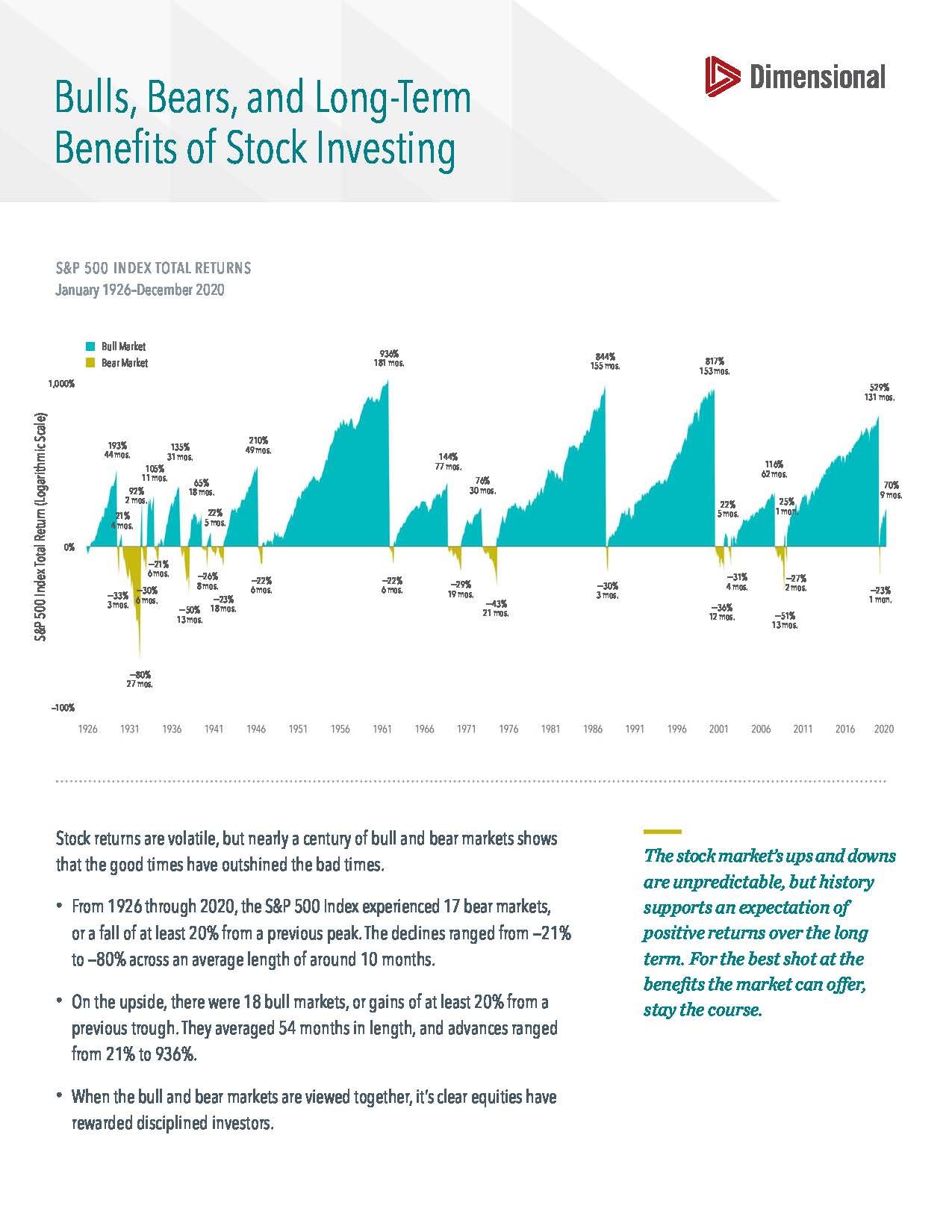
put up with the gold to be rewarded with the green (or is it teal or turquoise?). Stock market investing comes with bull (stocks up) and bear (stocks down) markets, but the bull markets are stronger and last longer. Think of the stock market as a constant bull market that is temporarily interrupted by short-lived bear markets. We don’t know when the next bear market will occur. It’ll happen at some point, fortunately, it won’t last long and it’s only temporary. If your retirement portfolio supports stock exposure, take the little bit of bad with a whole lot of good and stay invested through the good times and the bad times and you will build wealth for a safe, secure, and comfortable retirement. See the below picture or this PDF from Dimensional for more information.
ARE YOU CONFUSED BY THE CONTRAST IN THE ECONOMY AND THE STOCK MARKET?
Do you find it puzzling the recent stock market performance when you compare it to what is going on in the U.S. (and the world)? Each week millions more are filing for unemployment, the U.S. unemployment rate is north of 14%, bleak and dismal economic reports are coming out weekly, and now recent protests have led to nationwide unrest, riots, and looting…but the S&P 500 has rebounded about 38% from its March 23rd low, and it is currently at a price we saw in the beginning of March. It seems like it shouldn’t be this way, so why the disconnect?
It’s because stock markets are forward-looking. Meaning today’s prices reflect market participants’ combined expectations of future economic developments, not specifically what is happening right here right now. Remember stock is ownership in a company; holding stock entitles the stockholder to future earnings (and to participate in capital appreciation of the company), so investors care less about today and more about tomorrow.
Let’s go back to the end of February / beginning of March when we started to get a better understanding of what could happen with a novel coronavirus outbreak, and what could happen if we do something about it now or if we don’t do anything about it. It was a lot of speculation, dealing with an unknown, and preparing for the worst while hoping for the best. And the stock market and our retirement portfolios suffered drastically because of it, dropping 15% - 25% (depending on your allocation to stock) over just a couple weeks. Comparing now to then, investors believe better days are ahead.
Furthermore, stock markets are the first to react to good and bad news because it’s so easy for millions of market participants to put money into the system or take money out. Any type of unrest or uncertainty and the stock market quickly and easily goes down; likewise, any positive news, or even times when bad news isn’t as bad as expected and the stock market quickly and easily goes up. Remember, markets move quickly!
With that understanding, our approach is to use the stock market as it aligns with our personal financial and retirement goals. Whether economic uncertainty is prevalent today or a better economic outlook is popular now, whatever the case, we shouldn’t let the expectations of other market participants influence our personal decisions. We need to filter out the noise and not let it impact us nor our retirement portfolios. We use stock markets to align with our goals and our expectations, not the goals nor expectations of others.