
Here you can view the quarterly report for Q3, 2018, it concludes with a write up called The Total Price of Ownership. Owning shares of a mutual fund come with a cost. Some mutual fund companies charge you a “load” or a commission to purchase or sell their mutual fund, while all mutual funds have operating costs and manager compensation baked into the price of the fund. This baked in cost is known as the expense ratio; an expense ratio of .50% means a cost of $500 (paid by you, the investor) is baked into an investment of $100,000, for example.
Loads are unnecessary and can be easily avoided so we choose to only use mutual funds that are “no-load” funds. Expense ratios can’t be avoided, so we make sure to use mutual funds with smaller expense ratios, because the less you pay to invest the more you make. Keep in mind, as the article points out, expense ratios aren’t the end all be all when making fund selections and they don’t always tell the whole story when it comes to the cost of owning a fund. You can give the article a read for a more detailed dive into the total price of fund ownership.
Q3, 2019 Market Summary Report
Here you'll find DFA's Q3, 2019 Market Summary Report.
Everybody has or knows someone who has a great market timing story. Their story might be a little exaggerated or embellished, but it’s probably mostly true…of course, you typically only hear the good stories and not the bad ones. Market timing is tough, very tough. It requires picking the right time to get into a stock and the right time to get out of a stock – it’s doubly hard to get it right both times.
For every share of a stock bought, there is a share sold. Typically, this buying and selling is done at an exchange. The combined effect of all this buying and selling is that all available information is quickly incorporated into a stock’s price. So, trying to time the market based on an article you read, a TV show you watched, a chart you analyzed, or what your neighbor said is likely to send you chasing after old news. If only we could stay ahead of old news.
But what about professional stock pickers? They’re professionals, so they must know more than us, or be correct more often, right? Unfortunately, that’s not the case. Check out the linked article to learn why.
Missing the Market's Best Days...
You don't know when the good or bad market days will happen, so take the good (more often) with the bad (less often) and ride out every day cuz missing just a couple of the best days will have a huge impact on the health and wealth of your retirement portfolio…go here to see a 30 second video from Dimensional of what I'm talking about.
Q3, 2021 Market Summary Report
Q2, 2021 Market Summary Report
Here you’ll find the Q2, 2021 Quarterly Report. Q2 saw a strong performance from the stock and bond market, which you can see on page 3. The report wraps up with a synopsis of a conversation about inflation from Dimensional’s founder, David Booth and famed economist, Eugene Fama. I highlighted a favorite investing quote I use often: “Control what you can control.”
When it comes to investing in the stock market, we’ll do better if we can control and manage elements of investing that we can control in the first place. We can control time in the market, cost, the investments we choose, maximizing our tax-advantages, and a very important aspect, our emotions, too. When we understand these elements of investing, we significantly set ourselves up to have a more successful portfolio. Our emotions can get the best of us when we get caught up in the day-to-day movements of the stock market. Yesterday’s huge down day was a perfect example of why not to panic – it was just a tiny speed bump on a very long road. We don’t want to overreact. When we ignore what is out of our control and we understand what we can control and how best to go about it, we’ll reward our preparedness and diligence with a portfolio built for a safe, secure and comfortable retirement.
It's Pretty Simple...
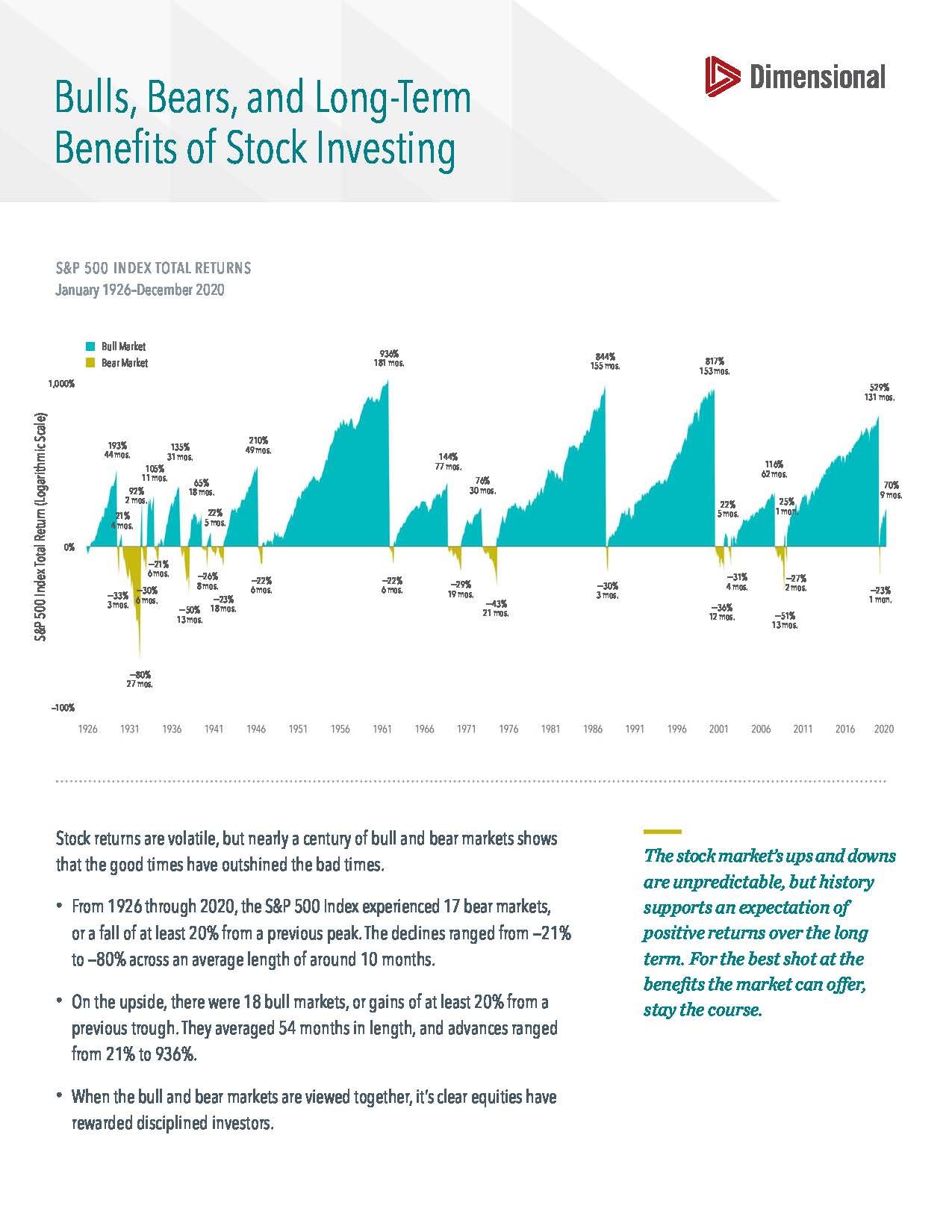
put up with the gold to be rewarded with the green (or is it teal or turquoise?). Stock market investing comes with bull (stocks up) and bear (stocks down) markets, but the bull markets are stronger and last longer. Think of the stock market as a constant bull market that is temporarily interrupted by short-lived bear markets. We don’t know when the next bear market will occur. It’ll happen at some point, fortunately, it won’t last long and it’s only temporary. If your retirement portfolio supports stock exposure, take the little bit of bad with a whole lot of good and stay invested through the good times and the bad times and you will build wealth for a safe, secure, and comfortable retirement. See the below picture or this PDF from Dimensional for more information.